You dream in a language that I can't understand
March 13, 2026
March 13, 2026
•
On language, love, and the Sapir-Whorf hypothesis
On language, love, and the Sapir-Whorf hypothesis
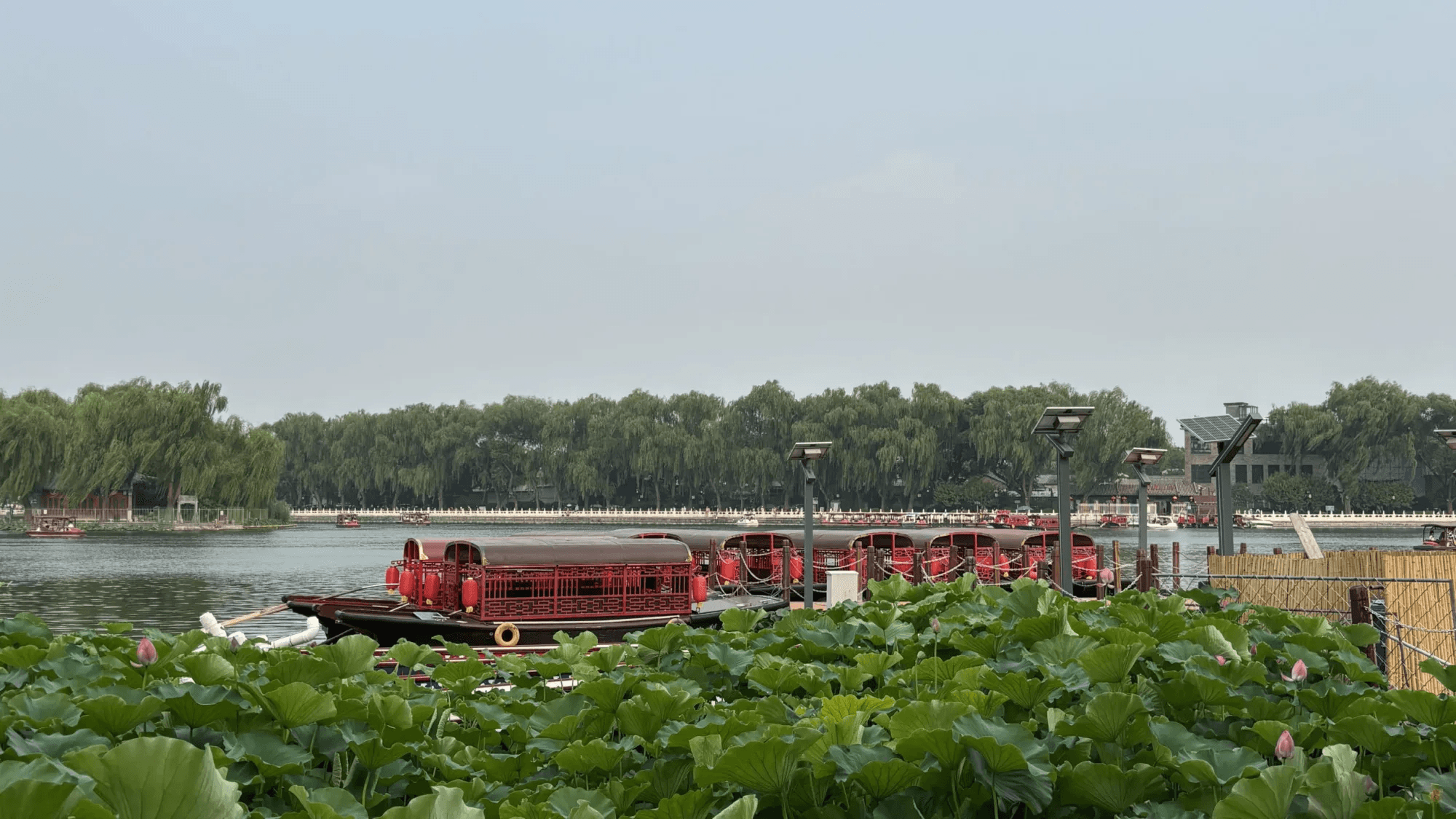
My visit of Shichichai, Beijing in 2024.
My visit of Shichichai, Beijing in 2024.
I’d like to think my mother tongue is something embedded within my genes, something innate, inevitable and instinctual. Like birds that migrate thousands of miles without a map, returning home to the same stretch of sky each year, I want to believe I was destined to speak it.
Yet, my Chinese has been deteriorating for years, words inevitably slipping from my mind one by one. For years, I have been asking my mom, “__用中文怎么说?” (How do I say __ in Chinese?). Shame and embarrassment follow along: I avoid phone calls with relatives, metaphors go in one ear and out the other, and I pause mid-sentence, blindly convinced the word will surface on its own, as if it’s something pre-programmed within me. Like if I just reach far down enough, maybe I’ll find where my words lie.
The film “Past Lives” follows Nora, a Korean immigrant who lives in New York with her husband Arthur, and her reunion with her childhood sweetheart Haesung after years apart. Language serves as a main theme within the film, with Arthur telling Nora, “You dream in a language that I can’t understand. It’s like there’s this whole place inside of you where I can’t go.” It suggests that language is more than communication; it is access. To speak, to think, to dream in a language someone else cannot understand is to possess an interior world unreachable to them. I can’t help but wonder whether the same was true within my own family: How much of my parents’ inner worlds remain just beyond my linguistic reach? I wonder how I am afraid that I will never fully understand my parents, how vastly different we are despite our physical proximity, how there may be parts of myself and my history even I cannot fully reach.
In a linguistics class, I learned about linguistic relativity and the Sapir-Whorf hypothesis, which argues that the structure of a language determines a native speaker’s perception and categorization of experience. The strongest version of the theory is debated, but its softer claims are compelling. If language guides attention — if it requires us to discern certain distinctions and not others — then it may subtly shape what we notice. For instance, my mom oftentimes refers to everyone as “he,” no matter how many times I correct her. She attributes it to pronouns in Chinese: 他 (he), 她 (she), 它 (it) are all pronounced “ta,” with gender distinctions only appearing in writing. English, in contrast, constantly reinforces gender in both speech and writing.
Part of the study of linguistics is essentially mapping out what different cultures have deemed important enough to name. In Greek, there are at least six different words to describe love: agape (unconditional), eros (romantic and sexual), philia (friendship), storge (familial), philautia (self-love), xenia (hospitality). Even in “Past Lives,” the characters discuss 인연, a belief concerning providence, fate and destiny — a concept that lays the foundations for the entire film’s understanding of connection.
To be honest, I don't think translation will ever be entirely accurate. Sure, simple equivalencies exist: 夹克 means jacket and 水 means water. But the moment we try to express who and how we are, the cracks appear. My dad, who I am not particularly close to, often asks me if I’ve eaten (吃了吗). On the surface, this is nothing but a simple question, but I find it inexplicably more profound than a simple hello (你好). How are you? Have you actually eaten? Are you happy? Are you tired? I haven’t seen you since school started, are you taking care of yourself? My dad often greets me this way, and no English phrase carries the same weight of concern wrapped in such casual words. As much as linguistics claims to be systematic, there’s this inexplicable complexity to human connection that cannot be broken down or analyzed. Each language is shaped by what its speakers need to express, what distinctions matter most, and therein lies the difference.
Similarly, I was very close with my grandmother growing up. So, when I visited China two summers ago for the first time in sixteen years, it seemed like the most daunting thing I would ever encounter: to stand before someone I loved and not have the words to tell them. How could I compress sixteen years into the elementary fragments of Chinese I still possessed? My challenges? My accomplishments? My life without her? And above all else, how could I even begin to learn about hers?
During our time together, my grandmother often recounted her memories of me as a child. Frankly, I don’t really remember much of them, yet she preserved them despite nearly two decades: my favorite foods, the sheet music she taught me to read, the cartoons I insisted on watching over and over again. While my Chinese and her English had faded with time, her memories had not. Equipped with nothing but a bond from years ago, Apple Translate and my younger cousin’s (commendably) great English, I began to understand connection beyond its traditional representations and in the very act of trying.
Toward the end of my visit, she pointed out the national map taped to the hallway wall, tracing each province with her fingertips. She had a dream to travel the country while she still could and wished the same for me, naming the best seasons to visit each province, the most optimal routes, the places I had to see. I promised I would come back the following spring. Yunnan and Jiangsu, she said, were nice that time of year.
Chinese has always been easier to hear than to speak; I could understand her far more than I could respond, following what she meant even when my own words were slow and uncertain. Nevertheless, even while I couldn't comprehend every word, I understood how much intention and care lay behind them. And while I can only say it plainly in my mother tongue (我爱你, I love you), we both know I mean so much more than that.
Before my visit, I spent most of my life viewing language as a fundamental barrier between my family and I — that nobody would understand me to my very core simply because of the way we communicate. Does my grandmother remember our moments differently than I do? When I think about my childhood, am I recalling the same events she does, or have our languages split it into two separate stories? Perhaps love requires accepting that there will always be parts of another person’s experience you cannot fully understand. Perhaps that is it in its purest form: knowing you may never fully grasp every corner and crevice of someone else and loving them anyway.
Recently, I’ve been thinking about how lucky I am to be able to experience two linguistic worlds, even if it comes with mistakes and mishaps. For all the barriers language creates, love is inherent within every one. So, I will continue to learn because, perhaps, love is not the act of successful conversation, but the will to try, over and over again.
Then, to answer my earlier questions: I’m not quite sure, but when someone dreams in a language that I can’t understand, I think about how wonderful it is to always have more to learn about them.
I’d like to think my mother tongue is something embedded within my genes, something innate, inevitable and instinctual. Like birds that migrate thousands of miles without a map, returning home to the same stretch of sky each year, I want to believe I was destined to speak it.
Yet, my Chinese has been deteriorating for years, words inevitably slipping from my mind one by one. For years, I have been asking my mom, “__用中文怎么说?” (How do I say __ in Chinese?). Shame and embarrassment follow along: I avoid phone calls with relatives, metaphors go in one ear and out the other, and I pause mid-sentence, blindly convinced the word will surface on its own, as if it’s something pre-programmed within me. Like if I just reach far down enough, maybe I’ll find where my words lie.
The film “Past Lives” follows Nora, a Korean immigrant who lives in New York with her husband Arthur, and her reunion with her childhood sweetheart Haesung after years apart. Language serves as a main theme within the film, with Arthur telling Nora, “You dream in a language that I can’t understand. It’s like there’s this whole place inside of you where I can’t go.” It suggests that language is more than communication; it is access. To speak, to think, to dream in a language someone else cannot understand is to possess an interior world unreachable to them. I can’t help but wonder whether the same was true within my own family: How much of my parents’ inner worlds remain just beyond my linguistic reach? I wonder how I am afraid that I will never fully understand my parents, how vastly different we are despite our physical proximity, how there may be parts of myself and my history even I cannot fully reach.
In a linguistics class, I learned about linguistic relativity and the Sapir-Whorf hypothesis, which argues that the structure of a language determines a native speaker’s perception and categorization of experience. The strongest version of the theory is debated, but its softer claims are compelling. If language guides attention — if it requires us to discern certain distinctions and not others — then it may subtly shape what we notice. For instance, my mom oftentimes refers to everyone as “he,” no matter how many times I correct her. She attributes it to pronouns in Chinese: 他 (he), 她 (she), 它 (it) are all pronounced “ta,” with gender distinctions only appearing in writing. English, in contrast, constantly reinforces gender in both speech and writing.
Part of the study of linguistics is essentially mapping out what different cultures have deemed important enough to name. In Greek, there are at least six different words to describe love: agape (unconditional), eros (romantic and sexual), philia (friendship), storge (familial), philautia (self-love), xenia (hospitality). Even in “Past Lives,” the characters discuss 인연, a belief concerning providence, fate and destiny — a concept that lays the foundations for the entire film’s understanding of connection.
To be honest, I don't think translation will ever be entirely accurate. Sure, simple equivalencies exist: 夹克 means jacket and 水 means water. But the moment we try to express who and how we are, the cracks appear. My dad, who I am not particularly close to, often asks me if I’ve eaten (吃了吗). On the surface, this is nothing but a simple question, but I find it inexplicably more profound than a simple hello (你好). How are you? Have you actually eaten? Are you happy? Are you tired? I haven’t seen you since school started, are you taking care of yourself? My dad often greets me this way, and no English phrase carries the same weight of concern wrapped in such casual words. As much as linguistics claims to be systematic, there’s this inexplicable complexity to human connection that cannot be broken down or analyzed. Each language is shaped by what its speakers need to express, what distinctions matter most, and therein lies the difference.
Similarly, I was very close with my grandmother growing up. So, when I visited China two summers ago for the first time in sixteen years, it seemed like the most daunting thing I would ever encounter: to stand before someone I loved and not have the words to tell them. How could I compress sixteen years into the elementary fragments of Chinese I still possessed? My challenges? My accomplishments? My life without her? And above all else, how could I even begin to learn about hers?
During our time together, my grandmother often recounted her memories of me as a child. Frankly, I don’t really remember much of them, yet she preserved them despite nearly two decades: my favorite foods, the sheet music she taught me to read, the cartoons I insisted on watching over and over again. While my Chinese and her English had faded with time, her memories had not. Equipped with nothing but a bond from years ago, Apple Translate and my younger cousin’s (commendably) great English, I began to understand connection beyond its traditional representations and in the very act of trying.
Toward the end of my visit, she pointed out the national map taped to the hallway wall, tracing each province with her fingertips. She had a dream to travel the country while she still could and wished the same for me, naming the best seasons to visit each province, the most optimal routes, the places I had to see. I promised I would come back the following spring. Yunnan and Jiangsu, she said, were nice that time of year.
Chinese has always been easier to hear than to speak; I could understand her far more than I could respond, following what she meant even when my own words were slow and uncertain. Nevertheless, even while I couldn't comprehend every word, I understood how much intention and care lay behind them. And while I can only say it plainly in my mother tongue (我爱你, I love you), we both know I mean so much more than that.
Before my visit, I spent most of my life viewing language as a fundamental barrier between my family and I — that nobody would understand me to my very core simply because of the way we communicate. Does my grandmother remember our moments differently than I do? When I think about my childhood, am I recalling the same events she does, or have our languages split it into two separate stories? Perhaps love requires accepting that there will always be parts of another person’s experience you cannot fully understand. Perhaps that is it in its purest form: knowing you may never fully grasp every corner and crevice of someone else and loving them anyway.
Recently, I’ve been thinking about how lucky I am to be able to experience two linguistic worlds, even if it comes with mistakes and mishaps. For all the barriers language creates, love is inherent within every one. So, I will continue to learn because, perhaps, love is not the act of successful conversation, but the will to try, over and over again.
Then, to answer my earlier questions: I’m not quite sure, but when someone dreams in a language that I can’t understand, I think about how wonderful it is to always have more to learn about them.
